
अब से हम Elev8 हैं
हम केवल एक ब्रोकर नहीं हैं। हम एक ऑल-इन-वन ट्रेडिंग इकोसिस्टम हैं—आपको विश्लेषण करने, ट्रेड करने और बढ़ने के लिए जो कुछ भी चाहिए, वह एक ही स्थान पर है। क्या आप अपने ट्रेडिंग को ऊँचा उठाने के लिए तैयार हैं?
हम केवल एक ब्रोकर नहीं हैं। हम एक ऑल-इन-वन ट्रेडिंग इकोसिस्टम हैं—आपको विश्लेषण करने, ट्रेड करने और बढ़ने के लिए जो कुछ भी चाहिए, वह एक ही स्थान पर है। क्या आप अपने ट्रेडिंग को ऊँचा उठाने के लिए तैयार हैं?
Gold (XAU/USD) edges higher during the Asian session on Friday and looks to build on the overnight bounce from the vicinity of the $3,500 psychological mark. The commodity remains within striking distance of the all-time peak touched this week and continues to draw support from a combination of factors. The growing acceptance that the US Federal Reserve (Fed) will deliver at least two 25-basis-point (bps) rate cuts by the end of this year, starting this month, keeps the US Dollar (USD) bulls on the defensive and continues to underpin the non-yielding yellow metal. Adding to this, trade-related uncertainties further benefit the safe-haven commodity.
However, the upbeat mood – as depicted by a generally positive tone around the equity markets – might keep a lid on the Gold price amid still overbought conditions on short-term charts. Traders might also refrain from placing aggressive bets and opt to wait for the release of the closely-watched US monthly employment details, due later during the North American session. The popularly known US Nonfarm Payrolls (NFP) report could provide cues about the Fed's rate-cut path, which, in turn, will drive the USD and the XAU/USD pair in the near term.
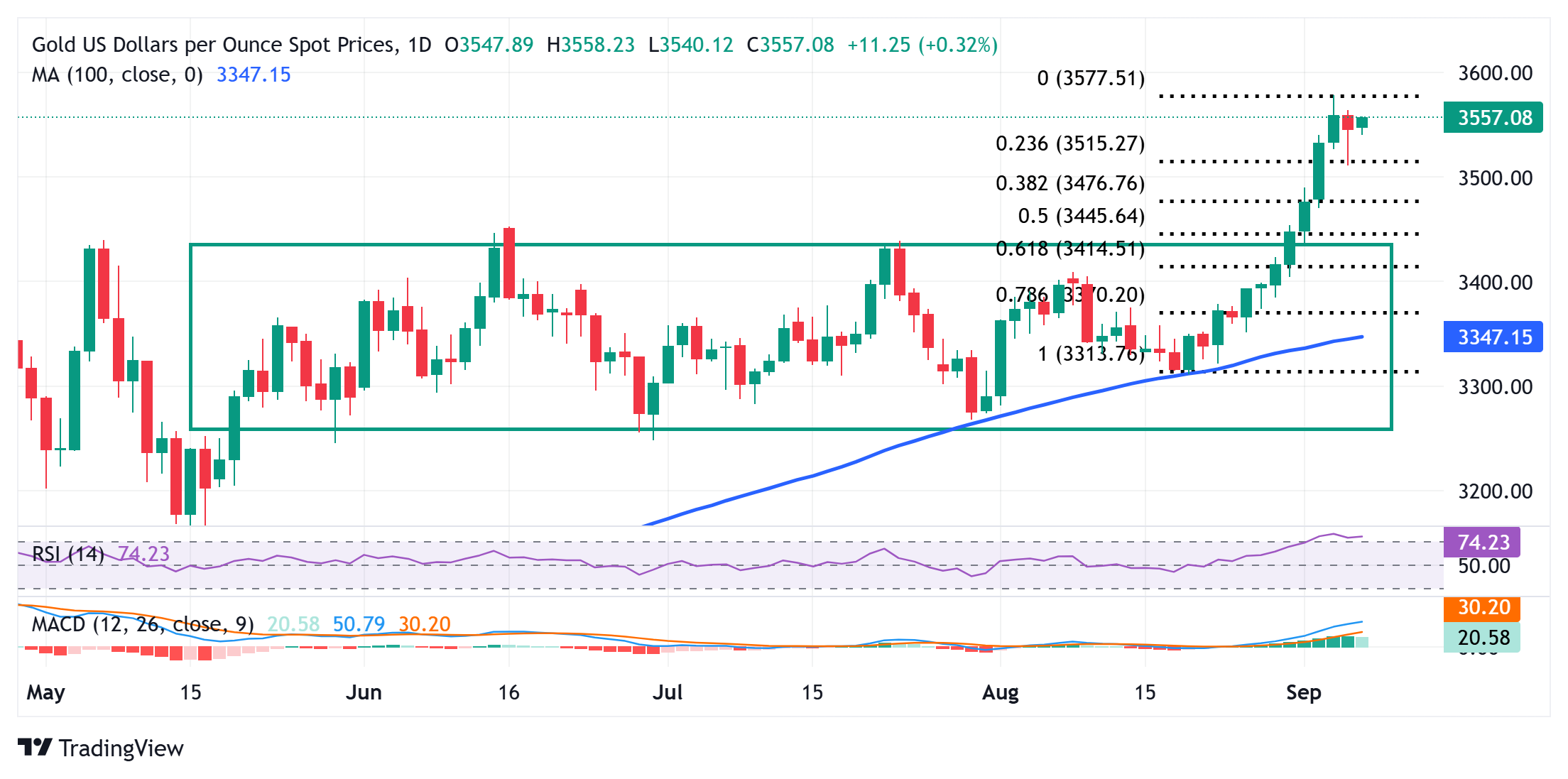
The overnight bounce from the 23.6% Fibonacci retracement level of the recent rally from the vicinity of the $3,300 mark, or the 100-day Simple Moving Average (SMA) support, comes on top of the recent breakout through a multi-month-old range. This, in turn, favors the XAU/USD bulls, though the overnight daily Relative Strength Index (RSI) makes it prudent to wait for some consolidation or a modest pullback before the next leg up.
In the meantime, any further move up beyond the $3,560 area is likely to confront some barrier near the $3,578-3,579 region, or the all-time peak touched on Wednesday. The subsequent momentum in the uncharted territory should allow the Gold price to aim towards conquering the $3,600 mark, or the trading range breakout target.
On the flip side, any corrective pullback might continue to find decent support near the 23.6% Fibo. retracement level, ahead of the $3,500 psychological mark. Some follow-through selling could pave the way for a deeper corrective slide to the $3,440 area, or the trading range resistance breakpoint. A convincing break below the latter will suggest that the Gold price has topped out and shift the near-term bias in favor of bearish traders.
Monetary policy in the US is shaped by the Federal Reserve (Fed). The Fed has two mandates: to achieve price stability and foster full employment. Its primary tool to achieve these goals is by adjusting interest rates. When prices are rising too quickly and inflation is above the Fed’s 2% target, it raises interest rates, increasing borrowing costs throughout the economy. This results in a stronger US Dollar (USD) as it makes the US a more attractive place for international investors to park their money. When inflation falls below 2% or the Unemployment Rate is too high, the Fed may lower interest rates to encourage borrowing, which weighs on the Greenback.
The Federal Reserve (Fed) holds eight policy meetings a year, where the Federal Open Market Committee (FOMC) assesses economic conditions and makes monetary policy decisions. The FOMC is attended by twelve Fed officials – the seven members of the Board of Governors, the president of the Federal Reserve Bank of New York, and four of the remaining eleven regional Reserve Bank presidents, who serve one-year terms on a rotating basis.
In extreme situations, the Federal Reserve may resort to a policy named Quantitative Easing (QE). QE is the process by which the Fed substantially increases the flow of credit in a stuck financial system. It is a non-standard policy measure used during crises or when inflation is extremely low. It was the Fed’s weapon of choice during the Great Financial Crisis in 2008. It involves the Fed printing more Dollars and using them to buy high grade bonds from financial institutions. QE usually weakens the US Dollar.
Quantitative tightening (QT) is the reverse process of QE, whereby the Federal Reserve stops buying bonds from financial institutions and does not reinvest the principal from the bonds it holds maturing, to purchase new bonds. It is usually positive for the value of the US Dollar.